Subscribe for Official Updates
Receive official announcements, press releases, and event notices from the Ajman Government Media Office.

Receive official announcements, press releases, and event notices from the Ajman Government Media Office.
 October 29, 2026
 Ajman Media Office
 general news
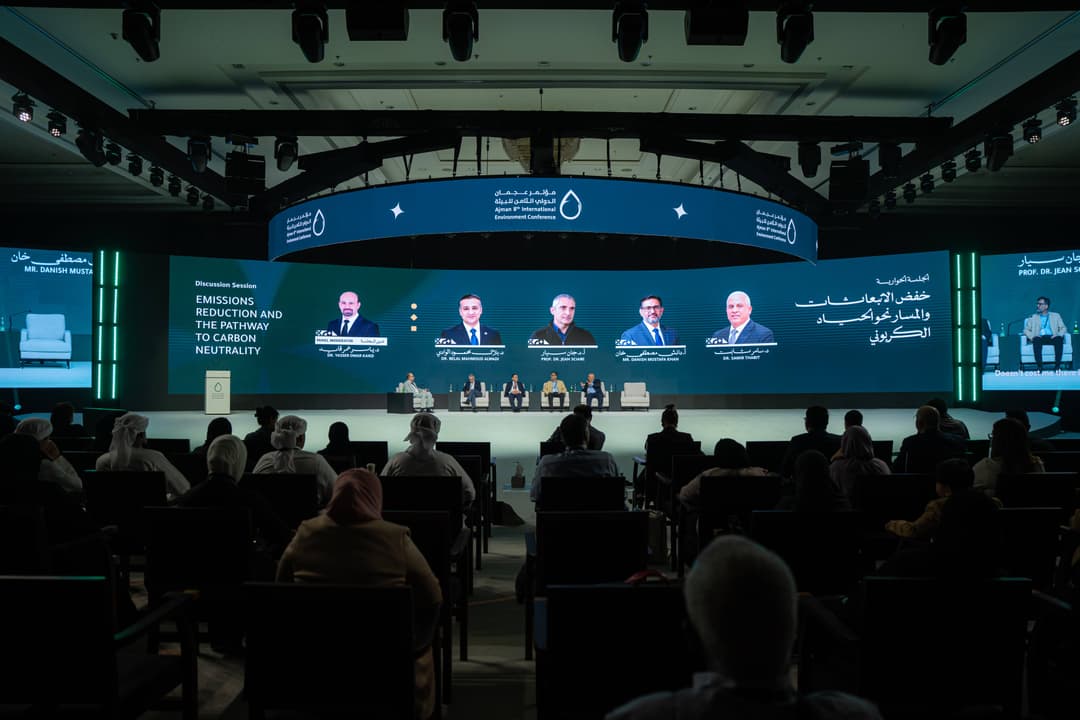
The Eighth Ajman International Environment Conference 2026 concluded with five key recommendations aimed at advancing the circular economy, adopting advanced technologies to reduce carbon emissions, employing artificial intelligence in environmental sustainability, developing a smart environmental monitoring ecosystem, and expanding green infrastructure solutions.
The recommendations support Ajman’s efforts to achieve carbon neutrality, advance sustainable development and build cities that are more resilient and capable of addressing climate challenges.
Organised by Ajman Municipality & Planning Department on 28 and 29 October at the Sheikh Zayed Centre for Conferences and Exhibitions at Ajman University, the Conference was held under the theme: “From Commitment to Implementation: Towards Sustainability, Enhanced Climate Resilience and Carbon Neutrality.”
The event attracted more than 1,500 attendees and featured more than 40 speakers from 15 countries. Its scientific programme included five scientific sessions, two opening panel discussions and six specialised workshops, presenting the latest global experiences and practices in sustainability and climate action.
The Conference served as an international platform for exchanging knowledge and expertise and strengthening integration between environmental policy, scientific research and technical applications. It aligned with the objectives of Ajman Vision 2030, the UAE Net Zero 2050 Strategy, and the United Nations Sustainable Development Goals 2030—particularly those related to sustainable cities and communities, responsible consumption and production, and climate action.
The Conference outcomes build on Ajman’s environmental efforts to advance sustainability and enhance quality of life. The emirate has recorded a 10% reduction in carbon emissions, while its air quality index has reached 98%. These results reflect progress in developing the environmental management system and adopting sustainable solutions and practices, while highlighting the importance of building on these achievements through advanced technologies and environmental initiatives.
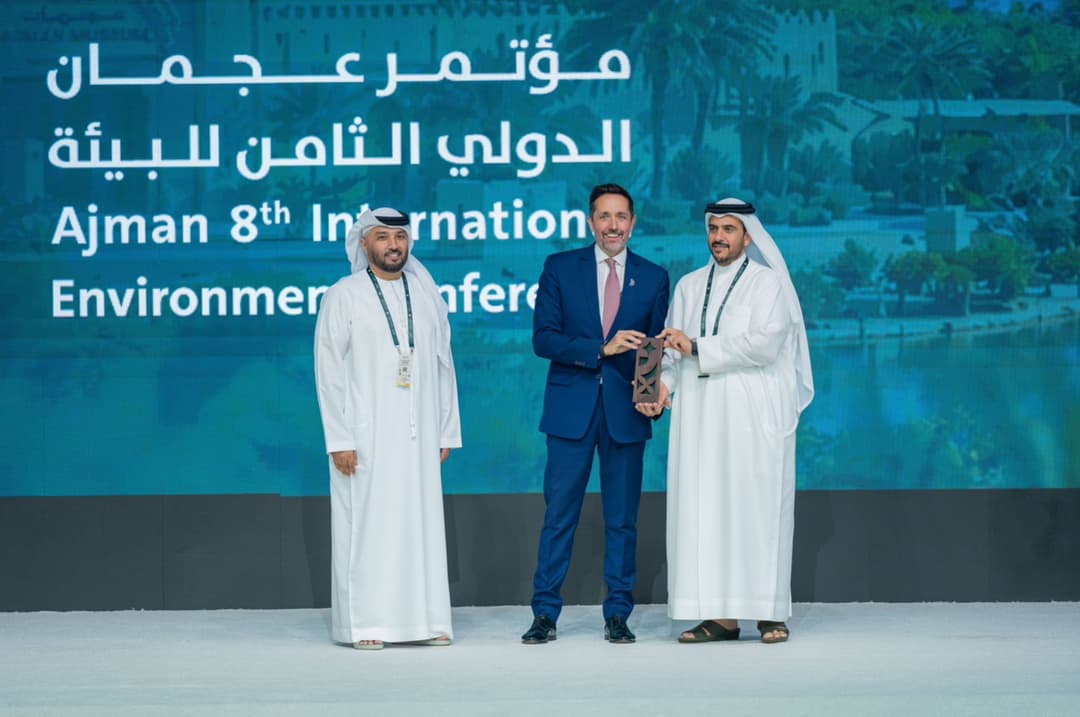
On the second day, Dr Engineer Khalid Moeen Al Hosani, Executive Director of the Public Health and Environment Sector and Chairman of the Conference’s Higher Committee, honoured the participating speakers in recognition of their scientific contributions and role in enriching discussions and exchanging leading expertise and experiences in environment and sustainability.
As part of efforts to advance community sustainability and embed environmental awareness among future generations, the Conference hosted assessment activities for the Zero Carbon Schools Initiative, in cooperation with the Ministry of Education, the Private Education Affairs Office – Ajman Government, and Ajman University, with the participation of 30 public and private schools in the emirate.
Participating schools presented their environmental projects and practices before a specialised evaluation committee representing the partner entities. Assessment was conducted according to unified criteria covering energy and water conservation, waste management and recycling, and raising environmental awareness among students and the wider school community.
The assessment activities form part of an initiative involving more than 85 schools across the Emirate of Ajman. The initiative encourages educational institutions to adopt practices that reduce their carbon footprint and strengthen the education sector’s role in embedding a culture of sustainability and developing a generation conscious of its environmental responsibility.
The Conference’s scientific sessions addressed sustainable urban development and low-carbon planning; climate change adaptation and nature-based urban solutions; AI-enabled environmental governance; integration between green infrastructure and renewable energy; and enhanced climate resilience, risk reduction and cities’ preparedness to address disasters.
Experts presented advanced applications involving the use of artificial intelligence and smart sensors for air-quality monitoring, predictive analytics and early-warning systems, sustainable urban planning and carbon-footprint management, alongside solutions related to water security and climate-change adaptation.
The six workshops focused on employing the Internet of Things and artificial intelligence in environmental monitoring and smart governance, carbon management, product life-cycle assessment, data analysis to support decision-making, and translating climate commitments into local actions that contribute to building sustainable and resilient cities.
The Conference concluded with five key recommendations, affirming the importance of adopting circular economy principles throughout all stages of the product life cycle and benefiting from the Ajman Circular Economy Platform, launched during the Conference, in order to reduce emissions and enhance resource-use efficiency.
The recommendations also stressed the need to expand the adoption of advanced technologies and smart solutions to monitor and reduce carbon emissions and support the transition towards a low-carbon economy.
They called for greater deployment of artificial intelligence applications in environmental monitoring, data analytics and emissions forecasting, as well as for the development of smart environmental monitoring systems that contribute to better air quality and informed environmental decision-making. The recommendations also emphasised the importance of benefiting from the innovative experiences and applications presented at the Conference.
The recommendations further highlighted the importance of expanding the application of green infrastructure technologies to reduce emissions and enhance urban sustainability, while taking economic feasibility into account and achieving a balance between environmental protection and economic growth. This supports the transition from climate commitments to practical, implementable initiatives and projects.
At the conclusion of its proceedings, the Conference affirmed the importance of building on its scientific outcomes and recommendations, strengthening cooperation among government entities, academic institutions and the private sector, and employing scientific research, innovation and advanced technologies to develop practical environmental initiatives and projects. Such efforts contribute to addressing climate challenges and enhancing the sustainability of cities and communities.
The outcomes of the Conference’s eighth edition embody Ajman’s direction towards establishing an integrated model of sustainable urban development that brings together environmental innovation, economic sustainability and community engagement. They reinforce the emirate’s position as a platform for international cooperation and expertise exchange, supporting the achievement of national and global sustainability objectives and contributing to a more sustainable future for generations to come.
سيتم ارسال صورة اخرى مهمة لتكون الصورة الرسمية الى الاخت شيماء المدد، نظرا لكبر حجم الصورة هنا
 Downloads:
 Press Release
 Photos