Subscribe for Official Updates
Receive official announcements, press releases, and event notices from the Ajman Government Media Office.

Receive official announcements, press releases, and event notices from the Ajman Government Media Office.
 November 27, 2026
 Ajman Media Office
 recognition and excellence
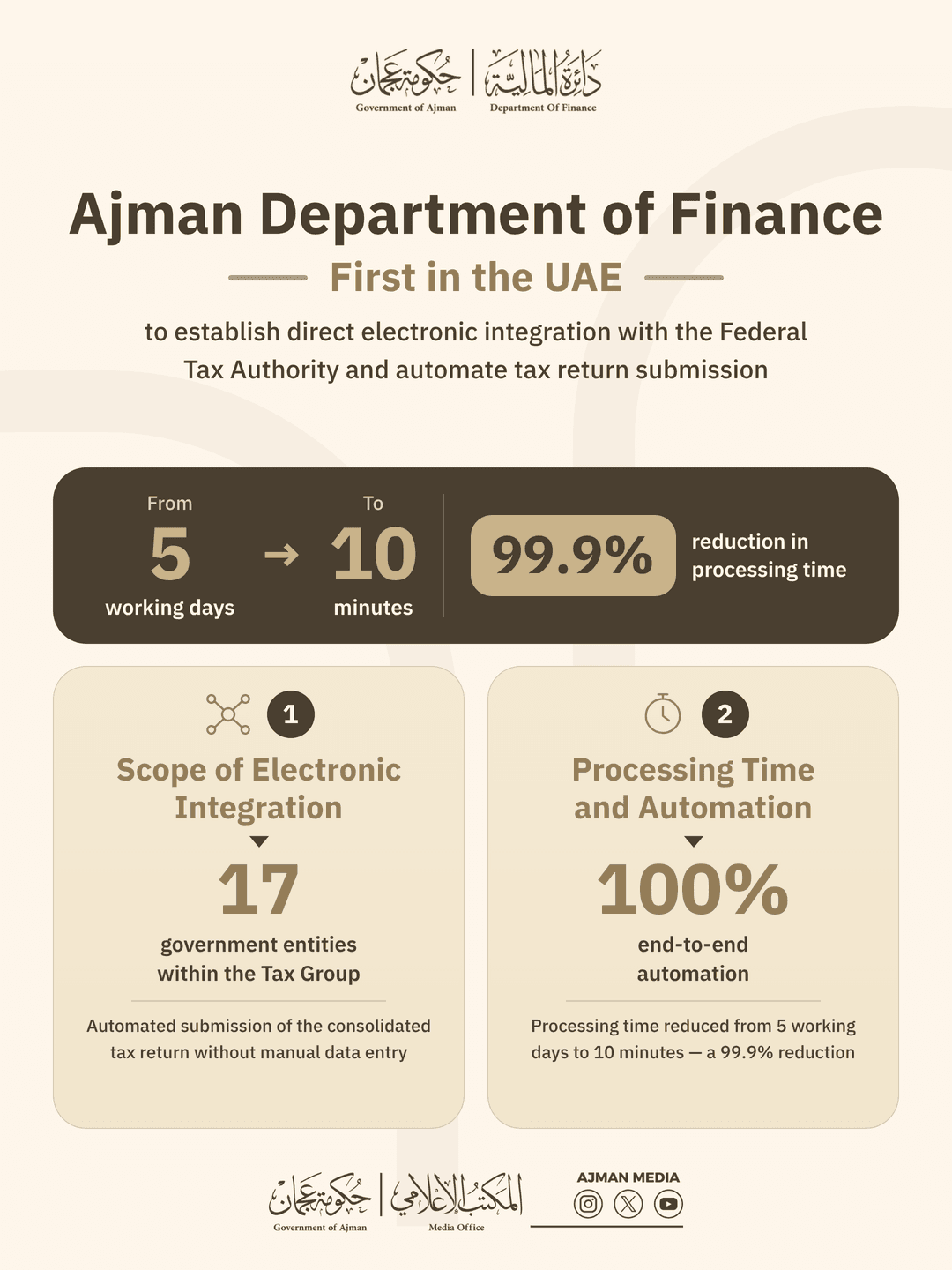
The Ajman Department of Finance has announced the full automation of the preparation and submission of tax returns for the Tax Group, becoming the first government entity in the UAE to establish direct electronic integration with the Federal Tax Authority (FTA). This enables the automated submission of the consolidated tax return without manual data entry.
The achievement covers 17 government entities within the Tax Group and forms part of the Department’s efforts to support the objectives of the Zero Government Bureaucracy Programme. By redesigning and simplifying financial procedures, the Department is moving from traditional processes to interconnected digital operations that save time and effort and enhance the overall government service experience.
The consolidated tax return is now prepared and submitted automatically through the system, from preparing the data to submitting the return to the Federal Tax Authority. No manual intervention is required to transfer data between systems, enhancing accuracy and reliability and improving procedural efficiency within an integrated digital cycle.
This achievement followed successive stages of development and improvement, during which tax return submission progressed from manual procedures to partial automation and ultimately to full electronic integration with the Federal Tax Authority.
These development stages reduced the time required to complete the entire process—from government entities preparing and submitting their tax reports to uploading the consolidated tax return into the Federal Tax Authority’s system—from five working days to ten minutes, while achieving 100% end-to-end automation.
This transformation reduces the administrative burden on teams and enables them to direct resources towards tasks that add greater value, enhancing operational efficiency and the quality of outputs.
His Excellency Abdulaziz Mohammed Al Mulla, Director General of the Federal Tax Authority, affirmed that this step forms part of efforts to strengthen institutional cooperation and integration among government entities. It aligns with the UAE’s commitment to expanding digital transformation, enhancing its global economic standing, and establishing an integrated, transparent tax system that facilitates tax compliance and supports financial sustainability.
He said: “Automating tax return submission exemplifies the significant transformation achieved across numerous tax services. This forms part of the Federal Tax Authority’s comprehensive strategy to implement the directives of the wise leadership to continue the third cycle of the Zero Government Bureaucracy Programme and continuously redesign and improve the customer experience across government services.”
He added: “The Authority’s efforts to eliminate bureaucracy have had a substantial impact on accelerating and simplifying tax procedures. Automation has also strengthened the Authority’s capacity to employ AI-assisted models, improving the accuracy of outputs and operational efficiency and contributing to the delivery of proactive digital services.”
For his part, His Excellency Marwan Ahmed Al Ali, Director General of the Ajman Department of Finance, said: “Establishing electronic integration with the Federal Tax Authority and fully automating tax return submission represents a significant achievement that reflects the Department’s leadership in developing and simplifying government financial processes. It reaffirms our commitment to translating the objectives of eliminating bureaucracy and enhancing the overall government service experience into practical approaches and solutions that deliver a tangible impact on the customer experience.”
He affirmed that the Department will continue investing in digital solutions and strengthening integration among systems and relevant government entities. These efforts will contribute to building a more efficient and flexible financial ecosystem that meets Ajman Government’s aspirations, enhances future readiness, and aligns with Ajman Vision 2030’s direction towards government leadership through innovation and a focus on results.
Yousef Murad, Director of the Department’s Tax Affairs Office, said: “The full automation of tax return submission for the Tax Group provides a practical model for translating the objectives of eliminating bureaucracy into measurable results by redesigning procedures and leveraging direct digital integration with the Federal Tax Authority.”
He explained that the project’s impact extended beyond faster completion to simplifying workflows, eliminating traditional forms and files, and making more effective use of human resources, thereby enhancing the accuracy and reliability of outputs.
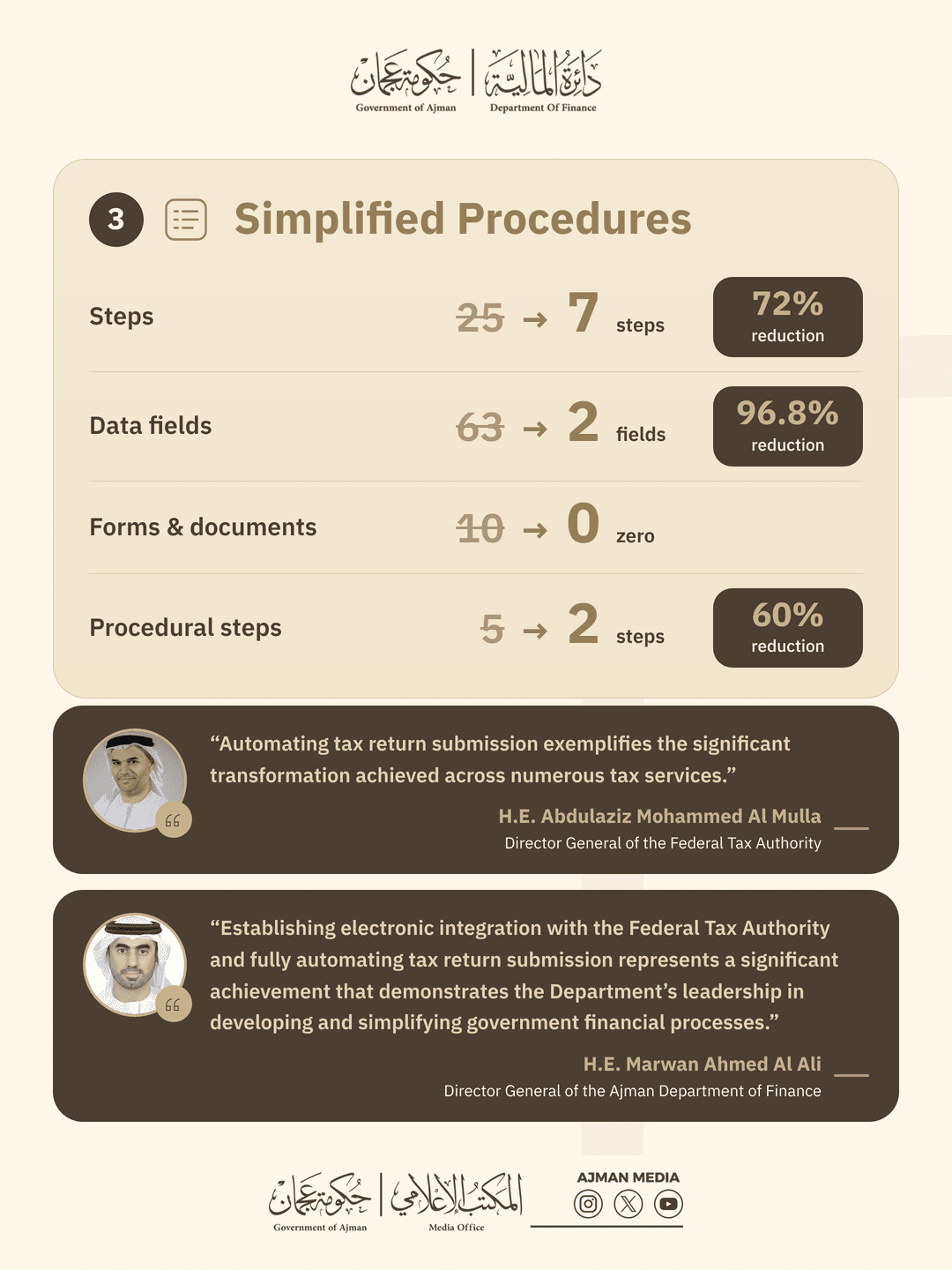
He added: “The indicators demonstrate the scale of the transformation achieved by the Department. The number of steps in the process fell from 25 to 7, representing a 72% reduction, while the number of procedures decreased from 5 to 2, a 60% reduction.”
He continued: “The number of forms and documents used fell from 10 to zero, the level of automation increased from 0% to 100%, and the number of fields requiring completion decreased from 63 to just 2, a 96.8% reduction.”
He noted that the Department also reduced the time required to complete the entire process—from government entities preparing their tax reports to uploading the return into the Federal Tax Authority’s system—from five working days to ten minutes, a 99.9% reduction in processing time, reflecting improvements in procedural efficiency and the management of time and resources.
This achievement reaffirms the Ajman Department of Finance’s commitment to embedding innovation, continuous improvement and digital integration as a sustainable institutional approach. It advances a model of government financial operations founded on simplicity, efficiency and reliability, employing technology not merely to automate procedures, but to redesign them and deliver smoother and more effective government services.
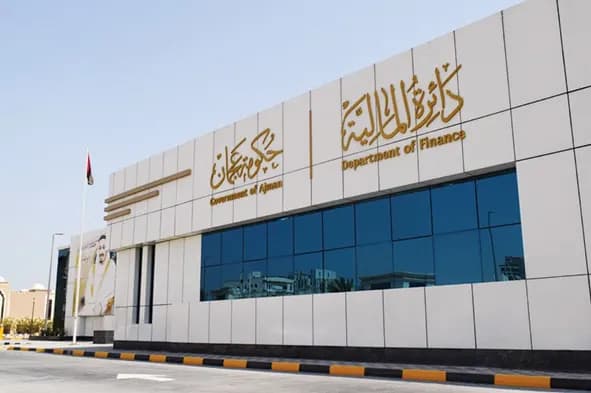
إبراز حصول دائرة المالية بعجمان على أربع شهادات دولية من معهد الابتكار العالمي، ونيل ستة من موظفيها صفة «مبتكر معتمد»، بما يعكس جهود الدائرة في ترسيخ ثقافة الابتكار وتطوير الكفاءات الوطنية وتعزيز التميز المؤسسي.
للنشر
 Downloads:
 Press Release
 Photos